What Does Central AC Installation Cost?
Key takeaways:
• The average cost to replace an existing AC unit can range from $8,600-$20,000+.
• Installing new ductwork can increase the cost substantially.
• Work with trusted HVAC professionals for long-term comfort and energy savings.
By Anne Fonda
Scenario #1: Central AC replacement
How does the number of cooling stages or speeds affect cost?
“While variable speed systems typically come with a higher upfront cost, they can deliver meaningful long-term savings through lower energy use. Because they run at lower speeds for longer periods, they maintain more consistent temperatures and noticeably improved comfort throughout the home.”
— Chelsea Hudson, Product Manager, Ducted Variable Speed Outdoor

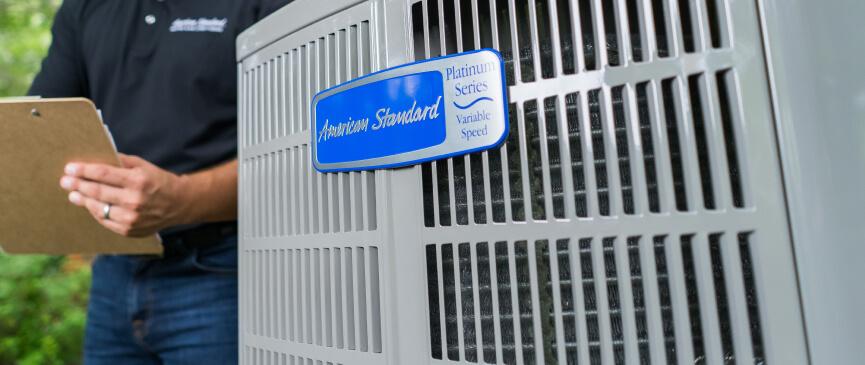
American Standard air conditioners are available in three types.
- Single stage – either on or off, which can use a lot of energy.
- Multi-speed – mid-range option with more speeds for better energy savings and comfort.
- Variable speed – longer run times at lower speeds, using less energy.
In general, the more speeds an air conditioner has, the greater your comfort level, temperature control, and energy efficiency. As you would expect, all of those benefits come with a higher upfront price tag.
However, the decreased energy consumption from a variable speed system can mean lower operating costs for years to come.
How does the SEER2 rating affect cost?
SEER2 stands for Seasonal Energy Efficiency Ratio. A SEER2 rating is a measurement of a unit’s cooling efficiency. The higher the SEER2 rating, the more energy efficient the air conditioner is.
In general, a higher SEER2 rating translates to a higher upfront cost. But again, the increased efficiency of the AC system can help reduce your energy consumption, leading to savings on your energy bills.
How does the capacity of the unit affect cost?
The cooling capacity of a central air conditioner is measured in tons. HVAC tonnage refers to how much heat your AC unit can absorb, rather than how much the unit weighs. A larger home size needs an AC unit with a higher tonnage.
Once again, larger capacity units will cost more than units with a smaller capacity. Air conditioners typically range in size from 2 tons to 5 tons, with half-sizes available for certain units.
“Choosing the correctly sized AC unit is one of the most important steps in the installation process. An undersized system will struggle to keep up on hot days, and an oversized one may short cycle, wasting energy. Proper sizing helps ensure the best balance of comfort, efficiency, and long-term system reliability.”
— Chelsea Hudson, Product Manager, Ducted Variable Speed Outdoor
To help ensure you get a properly sized system, your HVAC contractor should perform a load calculation. This takes into account much more than the square footage of your home.
How do local labor rates affect cost?
HVAC companies need to pay a decent hourly rate or salary to keep experienced HVAC technicians. Like any service company, they will pass part of that cost onto customers. If you live in a high-cost-of-living (HCOL) area, the labor costs for installing a central air conditioning system will be higher than for a homeowner installing the same unit in a low-cost-of-living (LCOL) area.
The best way to find out the cost of AC installation in your area is to get multiple quotes from local HVAC companies.
Scenario #2: Replacing the entire HVAC system
In many cases, if the furnace or air handler in your existing HVAC system is around the same age as the air conditioning unit you’re replacing, you may want to/need to replace the entire split system at the same time.
“Indoor and outdoor units are designed to work as a matched system. Replacing only one component can limit efficiency, reduce performance, or even create compatibility issues. When both units are the same age, replacing them together helps ensure optimal operation and can also reduce future labor costs by avoiding a second installation down the road.”
— Chelsea Hudson, Product Manager, Ducted Variable Speed Outdoor
Adding a new furnace or air handler at the same time will increase your overall costs by the price of the new unit, as well as associated labor costs. Read more about the reasoning for this in our Homeowner’s Guide to HVAC Replacement.
Scenario #3: AC installation + ductwork installation
The overall cost of central AC installation increases substantially if you need to install new ductwork at the same time, such as in an older home, home addition, or a home without a current ductwork system. In this scenario, you may want to obtain multiple quotes for both a ducted HVAC system and a ductless mini-split system.
If you’re building a new home, the cost of ductwork installation may be less since it’s easier to do. HVAC systems are typically installed before the drywall goes up. Nationally, the price can range from $3 to $7 per square foot, or roughly $10,000 to $20,000+ for a full system in a 2,000-2,500 sq ft home.
Keep in mind you may need to replace existing ductwork when you’re doing a system replacement. Ductwork typically lasts 15 years or so, with rigid sheet metal lasting longer than flexible ductwork.
Prices will vary significantly based on the same factors we listed above. Be sure your builder/general contractor works with experienced and licensed HVAC contractors to design an energy-efficient HVAC system and ductwork system for your home. New construction is the perfect time to include HVAC zoning for optimal comfort and energy savings.
“Zoning allows you to independently control temperatures in different areas of your home, so you’re only conditioning the spaces you actually use. That added control not only boosts comfort and reduces energy waste, but also helps minimize hot and cold spots, supports better humidity control, and can even reduce system wear over time. It’s an ideal solution for multistory homes, larger floorplans, or families with different comfort preferences.”
— Chelsea Hudson, Product Manager, Ducted Variable Speed Outdoor
Get multiple estimates
We’re not going to lie. Replacing your HVAC system is expensive. Just like when you’re shopping for a new car, do your homework and shop around. Understand how different systems can affect your comfort and your energy bills in the long run.
Whichever scenario fits you, be sure to get multiple estimates from local HVAC companies. If there are major differences, ask why, if it’s not obvious. Make sure each HVAC pro performs a load calculation to help ensure proper sizing.
Ask about available financial incentives and HVAC financing that can make getting a new energy-efficient heating and cooling system now more attainable. Not sure who to contact? Read our blog about how to choose the best HVAC company near you.
Work with trusted HVAC professionals
Your local American Standard dealer has the training and experience to deliver expert installation and maintenance services. Check out our HVAC Replacement Cost Guide for some price ranges, then reach out.
Anne Fonda, Content Writer
A Content Writer with Trane Technologies, Anne Fonda researches topics and writes for Trane® and associated residential HVAC brands. She works in collaboration with Trane Technologies subject matter experts, offering easy-to-understand, informative content on complex topics. Her goal is to help consumers make informed decisions on the products and services they need.
She has written for HVAC and other service provider websites for over 16 years. Before transitioning to web content writing, Anne had a 14-year stint as an award-winning journalist. She graduated cum laude from the University of Missouri-Columbia School of Journalism.
When she’s not working, Anne enjoys playing word games, reading, gardening, spending time with family, and visiting gardens and museums.
Expert review by Chelsea Hudson, Product Manager, Ducted Variable Speed Outdoor
Related articles