Heat Pump vs Air Conditioner: Which Is Better for Your Home?
Key takeaways:
• Both systems cool your home in the same way, the difference is how they will heat your home.
• To heat your home, an air conditioner will require some secondary heating device, such as electric heating strips or a gas furnace. A heat pump both cools and heats your home using the refrigerant system.
• Cooling efficiency is comparable for comparable units.

By Anne Fonda
What is a heat pump and how does it work?
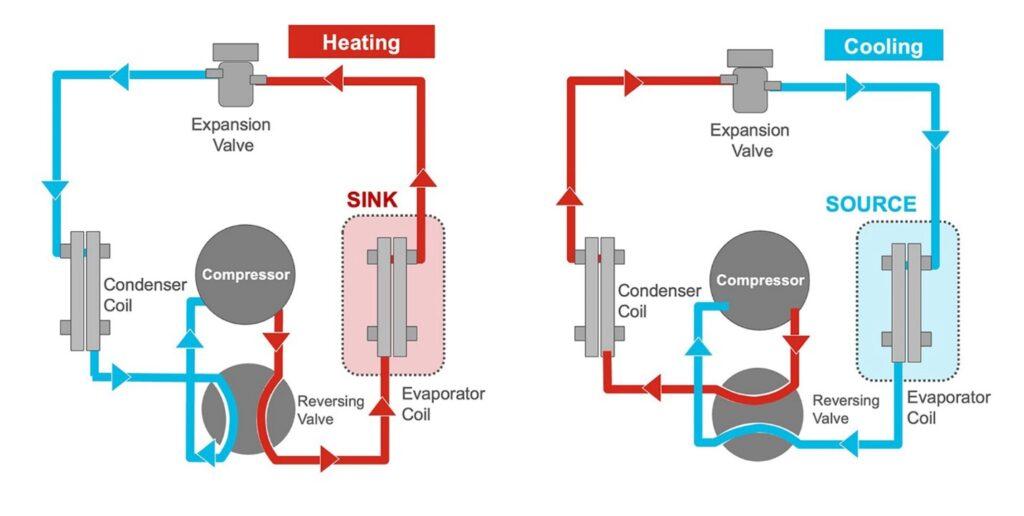
A heat pump uses the refrigeration cycle to heat or cool your home.
As you can see in the graphic below, a heat pump can reverse the direction of refrigerant flow for heating mode, or cooling mode. Air conditioners do not have this ability to reverse the refrigerant flow direction, and therefore they only operate in “Cooling” mode. With an air conditioner, heating mode is accomplished by a secondary heating method, usually electric heating strips or a gas furnace.
How are heat pumps and air conditioners different?
As discussed, air conditioners and heat pumps operate the same in the way that they cool your home, the main difference is that the heat pump can heat your home as well as cool it using the refrigerant cycle.
Both units look very similar and are similarly sized.
How does an air conditioner vs heat pump compare for efficiency?
For both types of cooling systems, cooling efficiency is represented by the unit’s Seasonal Energy Efficiency Ratio (SEER2). The higher the SEER2 rating, the more efficient the unit is at cooling your home.
For cooling efficiency, similar units have similar efficiency. For example, our most energy-efficient air conditioner, the AccuComfort™ Variable Speed Platinum 20 Air Conditioner, has a SEER2 of up to 23.6. Our most energy-efficient heat pump, the AccuComfort™ Variable Speed Platinum 20 Heat Pump, has a SEER2 rating of up to 22.4.
The exact SEER2 level your new HVAC system achieves will depend on multiple factors, such as the indoor unit it is paired with, your climate, and more.
What about heat pump vs air conditioner cost?
The cost of either system is very similar, with heat pumps costing just a bit more, since it does double duty, both heating and cooling. Your best bet to get an accurate cost comparison is to contact your local American Standard dealer.
Heat pump rebates
A big difference in the cost between the two can be if you qualify for a heat pump rebate under a state program. These rebates can be up to $8,000, depending on your state and your income.
In addition, many utility companies and HVAC manufacturers provide heat pump rebates. They may offer similar or smaller rebates for central AC units that meet efficiency requirements.
How long do each of these units last?
In general, you can expect a central AC unit to last 15 years. A unit might wear out sooner if you live in a hot and humid climate like Florida.
Also, in general, you can expect a heat pump to last 12-15 years. Because a heat pump runs year-round to both heat and cool your home, it might have a shorter lifespan. In both cases, you can prolong the life of your system with regular maintenance.
What’s the difference in maintenance needs?
With both systems, you will want to change the air filter regularly, every 30-90 days. Keep the area around the outdoor unit clear on all sides for proper airflow.
AC maintenance: Schedule a tune-up for your air conditioner each spring before cooling season begins.
Heat pump maintenance: Since your heat pump is both a heating and a cooling system, you will want to schedule a tune-up in the spring before cooling season, and another one in the fall before heating season, just like you would with a gas furnace.
Heat pump vs air conditioner climate suitability
You can reliably use a central air conditioner anywhere in the country. You can use a heat pump reliably for cooling anywhere in the country as well. Units with higher SEER2 ratings will keep you most comfortable.
Since a heat pump also heats your home, you will need to choose the heat pump that offers the best heating efficiency for your climate. This might be a standard heat pump, or a cold climate heat pump. Work with your local American Standard dealer to select the right heat pump system.
For milder climates, pairing a heat pump with an air handler equipped with electric heat strips for auxiliary heat is very common. For areas with colder winters, we would advise pairing the electric heat pump with a gas furnace in a dual fuel system.
“For homes with an existing AC + furnace system, a Hybrid, or dual fuel system is a fantastic option because you get the benefits of the heat pump but with the safety net of a gas furnace for those especially cold days plus you can avoid any additional cost for wiring which may be required when replacing the gas furnace with an air handler.”
- Mark Woodruff, Senior Product Manager, Ducted Outdoor, Trane Technologies
Get a free quote
Still not sure if a new central air conditioner or a heat pump system would be better for your home? Schedule a consultation with your local American Standard dealer to get answers specific to your home. They can assess your home, your heating and cooling needs, do a load calculation, and give you a free quote for both types of systems.
Anne Fonda, Content Writer
A Content Writer with Trane Technologies, Anne Fonda researches topics and writes for Trane® and associated residential HVAC brands. She works in collaboration with Trane Technologies subject matter experts, offering easy-to-understand, informative content on complex topics. Her goal is to help consumers make informed decisions on the products and services they need.
She has written for HVAC and other service provider websites for over 16 years. Before transitioning to web content writing, Anne had a 14-year stint as an award-winning journalist. She graduated cum laude from the University of Missouri-Columbia School of Journalism.
When she’s not working, Anne enjoys playing word games, reading, gardening, spending time with family, and visiting gardens and museums.
Expert review by Mark Woodruff, Senior Product Manager, Ducted Outdoor
Related articles


