What Is Considered High Humidity in Your Home?
Key takeaways:
• Humidity above 55% can feel uncomfortable, while humidity above 60% is considered high humidity and can be harmful to your health and your home.
• Upgrading your HVAC system or installing a whole-house dehumidifier are some of the best ways to lower the humidity and regain control of your comfort.
• Smart thermostats and indoor air quality monitors can help regulate indoor humidity.

By Anne Fonda
A quick lesson on humidity
First, a quick lesson on humidity. In a nutshell, it’s the amount of water vapor, or moisture, in the air. Relative humidity (RH) measures water vapor relative to the air temperature, and is expressed as a percentage.
We’ve all heard the phrase “It’s not the heat, it’s the humidity.” That’s because the humidity can make the air feel oppressive and make you feel hotter. Weather forecasts and real-time data give you the “Feels Like” temperature for this reason. This happens most often in the summer months for northern states.
For northern states, the humidity level naturally decreases in the winter months as the temperature drops. But for much of the Southeast, including the Gulf States, the humidity can stay high year-round.
What are some signs of high humidity in my house?
High humidity can result in a decrease in indoor air quality (IAQ), a decrease in comfort, and damage to your home. According to the Environmental Protection Agency (EPA) and the Cleveland Clinic, physical symptoms of high humidity can include:
- Condensation on walls and the inside of windows
- Mold and mildew growth
- Musty smell
- Peeling paint
- Warping or rotting wood
- Clammy feeling
- Trouble sleeping
- Fatigue
- Breathing difficulties
- Increase in allergy or asthma symptoms
Of course, some of these issues can be caused by something other than high humidity, so you may need to do a little detective work to get to the root cause.
What causes high humidity in a house?
A lot of things can cause high indoor humidity levels in your home; most of them are temporary problems. The good news is that there are solutions for both temporary issues and longstanding ones. Let’s take a look.
Drafty windows and doors
If you can feel a breeze coming in around your windows and doors, that means you’re letting humid air in and conditioned air out. Think about sealing around windows and doors, and check where plumbing pipes enter your house as well. Sealing gaps can increase comfort but can also help lower your energy bills. Not sure where to start? Consider a home energy audit.
Leaky pipes or flooding
A leaky pipe can go undetected for months or even years. This is especially true if the pipe is in a wall, under tile, or in another out-of-the-way area. A constant drip can lead to high humidity and encourage mold growth. You may discover the leak when you investigate a musty smell or during renovations.
It’s important to fix the leak or pump out floodwater and remove any damaged materials, such as drywall, carpeting, subflooring, or insulation, as quickly as possible. Once repairs are made, the humidity problem and musty smell should go away.
Water intrusion in your basement or crawlspace
If your basement is dark and damp, or you can see standing water in your crawlspace, you have a water intrusion issue. Left unattended, the water can cause high humidity, lead to mold growth, damage your home’s foundation, and more. You may see puddles on the floor, efflorescence on your basement walls, mold growth on cardboard boxes, and notice a musty smell.
Consider extending gutter downspouts by 6 feet (or more) away from your foundation, regrading your yard so that the ground slopes away from your foundation, crawlspace encapsulation, or basement waterproofing to stop the water intrusion.
The first two suggestions are inexpensive, while the second two can be expensive, but they all can help protect your home’s value and increase your comfort for years to come.
You live in a humid area
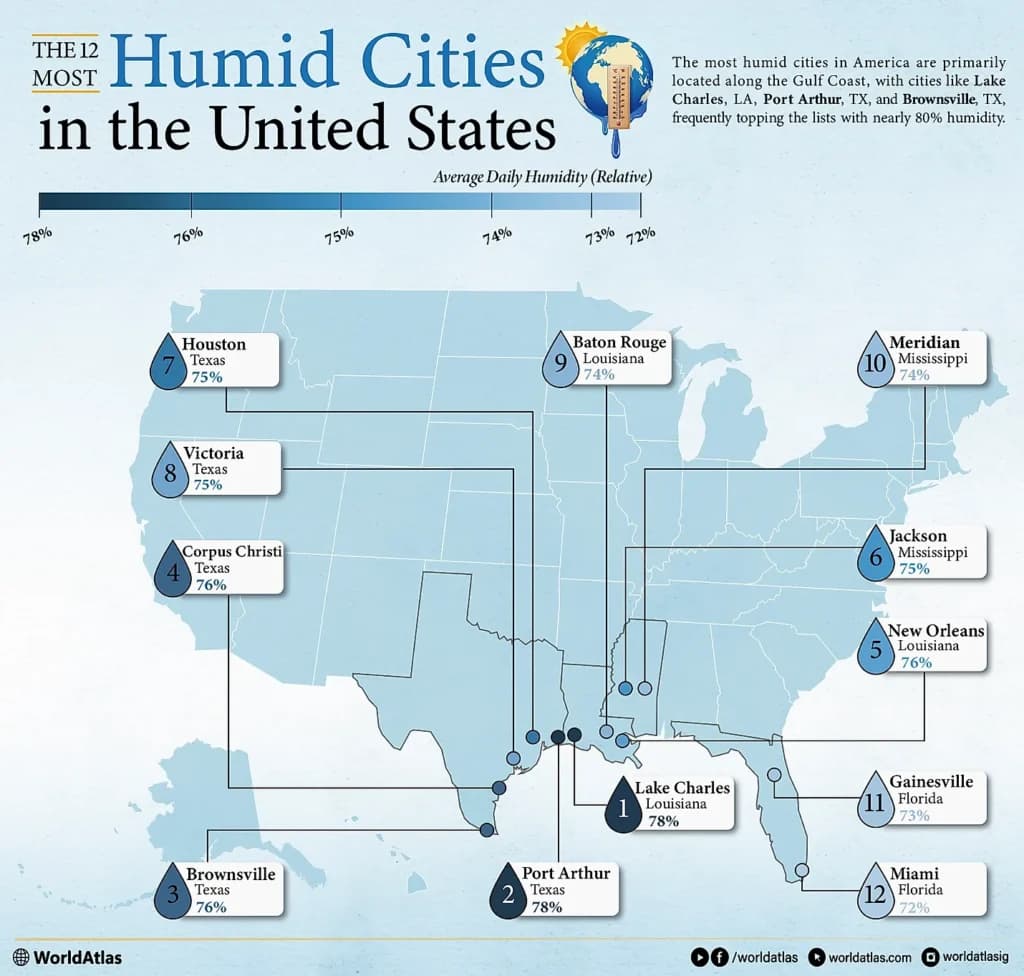
If you live in one of the most humid states or the most humid cities (we see you, Gulf Coast cities!), you can’t fix the source of the high humidity levels. You have to cope with it. If only the summers are hot and humid, that’s an easier fix. More on that in a moment.
How can I control high humidity at home?
For comfort and health reasons, the EPA recommends keeping indoor humidity between 30% and 50%. If your indoor humidity is above 60%, you need to take action to reduce it. Here are three basic ways to do that.
1. Use bathroom and kitchen vents
Does someone in your family take long, hot showers? Invest in a bathroom exhaust fan if you don’t have one already. Another option is to open a window in the bathroom. For your kitchen, use the stove exhaust fan and/or open a window. If it’s incredibly humid outside, opening a window is not advisable, so exhaust fans are a must.
2. Use a dehumidifier
Using a dehumidifier to reduce high humidity in your home can be a good solution. The type of dehumidifier you choose will depend on whether the problem is temporary or longstanding. And remember, you need to fix the source of the high humidity if you can, such as water intrusion in the basement, for example.
Temporary issue: If you’re trying to dry out your basement after flooding or dry out a room after a pipe burst, a portable dehumidifier should help do the trick. You’ll need to plan on emptying the reservoir frequently, or if you have a floor drain or can run a hose outside, some models allow you to connect a hose so that the water drains automatically.
Longstanding issue: If you live in an area with high humidity year-round, or your current HVAC system doesn’t remove enough moisture from the air, a whole-house dehumidifier can be a cost-effective solution, where you essentially set it and forget it after installation.
“Whole-home dehumidifiers reduce humidity in your space without the need for multiple in-room solutions, removing moisture from the air and disposing of the water without constant homeowner intervention. American Standard Whole Home Dehumidifiers offer top-of-the-line moisture removal capabilities.”
- Sean Goddard, Product Manager, Coils & Indoor Air Quality

3. Upgrade your HVAC system
Did you know that your air conditioner or heat pump removes moisture from the air every time it runs in cooling mode? But some AC units and heat pumps do a better job at dehumidifying than others.
For example, single-stage or two-stage systems, as well as oversized systems, may cool the air too quickly, preventing them from running long enough to remove excess moisture from the air.
If you have an aging heating and cooling system that will need to be replaced in the next few years, start looking into multi-speed and variable-speed systems. They do a better job of keeping a consistent temperature while removing moisture from the air at the same time. The result? You feel cool and comfortable instead of cold and clammy. They’re also more energy-efficient, which can save you money on your energy bills.
“The number of speeds or stages typically translates to energy efficiency and better comfort… so the more variability or number of stages, the more efficient the equipment will operate and the better temperature and humidity control the system can deliver to your home.”
- Mark Woodruff, Senior Product Manager, Air Conditioners

Monitor your indoor air quality
High humidity can negatively impact your indoor air quality by providing an environment where mold, mildew, and dust mites can thrive. But indoor pollutants, such as dust, smoke, and volatile organic compounds (VOCs), can also cause discomfort and health issues.
That’s why we now offer the Awair Element™ indoor air quality monitor. It integrates with the Home App, your smart thermostat, and your HVAC system to help you breathe easier.
Ask your local American Standard dealer about humidity control solutions
If your house feels humid all year long, or if your AC or heat pump struggles to remove moisture as it cools in the summer, your local American Standard dealer can help. After assessing your current HVAC system, your home’s insulation, and more, they will make recommendations to help you take control of your comfort.
Anne Fonda, Content Writer
A Content Writer with Trane Technologies, Anne Fonda researches topics and writes for Trane® and associated residential HVAC brands. She works in collaboration with Trane Technologies subject matter experts, offering easy-to-understand, informative content on complex topics. Her goal is to help consumers make informed decisions on the products and services they need.
She has written for HVAC and other service provider websites for over 16 years. Before transitioning to web content writing, Anne had a 14-year stint as an award-winning journalist. She graduated cum laude from the University of Missouri-Columbia School of Journalism.
When she’s not working, Anne enjoys playing word games, reading, gardening, spending time with family, and visiting gardens and museums.
Expert review by Sean Goddard, Product Manager, Coils & Indoor Air Quality